
MGB Region 6
MGB Region 6 has jurisdiction over the provinces of Aklan, Antique, Capiz, Guimaras, Iloilo, Negros Occidental. MGB Region 6 office is located at 2nd Level, Queen City, Garden Mall, J. de Leon St., Iloilo City, and can be contacted at the Tel. Nos. (033) 336-2815; 508-7533 or via email: mgb6iloilo@yahoo.com
October 11, 2011
Iloilo City – Regional Director Leo Van V. Juguan of the Mines and Geosciences Bureau Region-6 (MGB-6) cautions those who are living in areas that are highly prone to landslides to take precautionary measures now that Panay Island is expected to be hit by typhoon “Ramon” based on the PAG-ASA Weather Advisory.
As of 11:00 AM PAG-ASA advisory today, “tropical depression “Ramon” has maintained its strength as it continues to threaten Eastern Visayas and Northeastern Mindanao. Northern Negros, Northern Iloilo and Capiz are considered to be under storm signal No.1 together with the other areas in Visayas and Mindanao.
Director Juguan issued an advisory to all provinces reminding that based on the geohazard assessments conducted by MGB, there are areas in Region 6 that are highly prone to landslides. 
(Above) Sample Geohazard Map - San Joaquin Quadrangle)
All of the barangays in Region 6 were assessed for landslides and flooding risks in a rapid geohazard assessment conducted from 2006-2010. High risk barangays were given advisories for landslide and flooding risks.
(Click to view Geohazard Maps of provinces in Region 6.)
The provinces of Antique, Iloilo and Negros Occidental have the most number of barangays with high vulnerability to landslides.
In Antique, eight municipalities topped the most number of barangays as highly prone to landslides namely San Remigio, Patnongon, Laua-an, Hamtic, Valderrama, Sibalom, Barbaza and Tobias Fornier.
In Iloilo, the municipalities of Leon, Igbaras, Tubungan, Maasin, Alimodian, Lambunao, Calinog, Guimbal, San Joaquin and Miagao have the most number of high-risk barangays to landslides.
The municipalities in Negros Occidental that have the most number of high risk barangays are Cauayan, Calatrava, Hinoba-an, Sipalay, Isabela, Kabankalan, La Castellana and Salvador Benidicto.
These municipalities in the three provinces are subject of a more detailed geohazard assessment on a map scale of 1:10,000 to be completed within three years. Detailed geohazard mapping of the eight municipalities of Iloilo is targeted to be completed this year.
August 7, 2011
by
Elsa S. Subong of PIA-6 (With inputs from MGB-6 Press Release)
ILOILO CITY, August 7 (PIA) -– As disaster risk reduction and management cuts across all social services sector, the Mines and Geosciences Bureau (MGB) joined in the caravan initiated by the Office of the Ombudsman in Negros Occidental recently.
MGB-6 Regional Director Leo Van Juguan said disaster risk reduction and management is a social as well as economic and political responsibility of government agencies and the local government units, which should be delivered to the public.
Juguan said, the office has a mandate to inform the people that government through the MGB has the responsibility to promote exploration and development of the country’s mineral resources while safeguarding the environment and the rights of the affected communities.
In previous interviews with the Philippine Information Agency-6, Juguan said the province of Negros Occidental is a vibrant community where mining is concerned, because of so many potentials for exploration.
He said this situation often causes conflicts such that the MGB has to let the public understand that government is for responsible mining, based on existing laws that have provisions for regulation.
He said responding to the environmental, social, safety and health provisions of the mining law, the MGB Office conducts environmental monitoring of mining exploration areas, monitoring of compliance to safety, health and environmental standards, and issuance of permits related to safety, health, mechanical and electrical-related permits.
On the other hand, a major program of the MGB is the Geohazard Assessment and Mapping of disaster prone areas particularly landslides and flooding, for information and disaster management.
Juguan said the results of geohazards assessment and mapping is disseminated to all concerned, especially the local government units so that they can properly act.
MGB records showed that in Negros Occidental, towns with villages which are highly prone to landslides are San Carlos, La Castellana, Calatrava, Don Salvador bendictor, Isabela, Monteverde, Cadiz, Murcia, Cauayan, Silay, Candoni, Kabankalan, Ilog, and E.B. Magalona.
Juguan said joining the Ombudsman caravan to these areas is for the MGB to come face to face with communities which need reminders to take seriously the geohazard maps, act on them and minimize damages.
For the mining communities, Juguan expects better understanding of mining laws. (ESS/PIA-Iloilo/MGB-6)
Link to Story on PIA Region 6
May 26, 2011
Iloilo City – Regional Director Leo Van V. Juguan of MGB-6 said we must all brace ourselves for possible landslides and flooding with the onset of the rainy season and typhoons.
He said that areas which have been classified as highly and moderately susceptible for landslides in the geohazard assessment and mapping
should take precautionary measures at the coming of the rainy season. However, he said that typhoons come at any time of the year, so there is a need to be prepared all the time.
MGB-6 completed the rapid geohazards assessment and mapping on a scale of 1:50,000 of the whole Region 6 last year. Results of the assessment show the vulnerability of barangays for landslide and flooding.
Results of the geohazard assessment in Region 6 showed that of the total 4,054 barangays, there are 564 barangays classified as highly susceptible, while 550 barangays are moderately susceptible to landslides in the six provinces of the region.
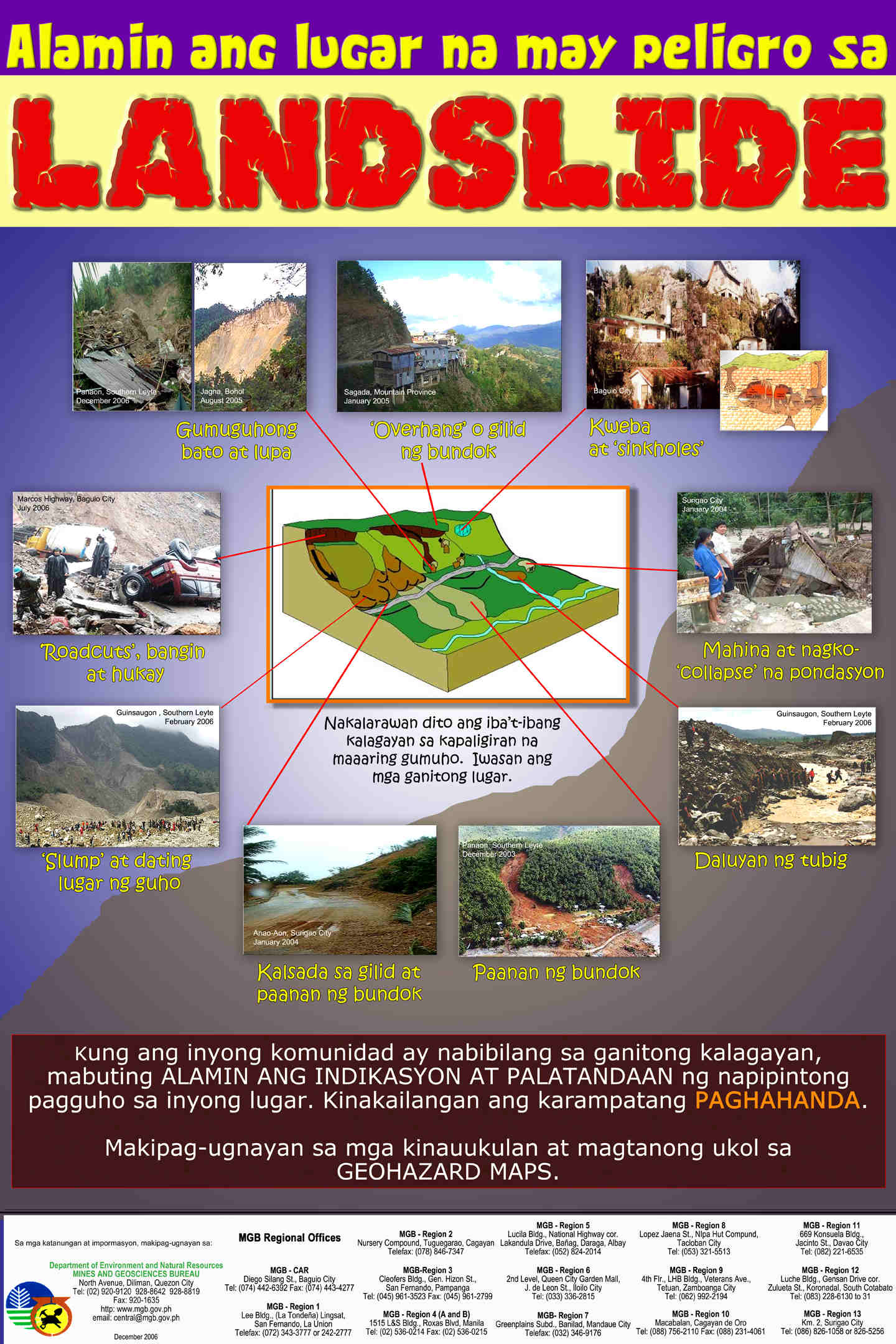
Areas classified as highly susceptible are those with presence of active faults, occurrence of recent landslides, presence of numerous and large tension cracks that would directly affect the community, presence of areas that are prone to landslide damming and have steep slopes.
Areas with inactive and old landslides, presence of smaller tension cracks and moderate slope are classified as moderately susceptible to landslides.
Of those assessed as highly susceptible barangays, 283 are in Iloilo; 185, Antique; Aklan, 30; Capiz, 30; Negros Occidental, 28; and Guimaras, 8.
In the province of Iloilo, highly susceptible barangays are the municipalities of Leon, Igbaras, San Joaquin, Miagao, Tubungan, Lambunao, Calinog, Alimodian, Concepcion, Janiuay, Carles, San Dionisio, Batad, Sara, Lemery, San Enrique, Maasin, Anilao, Barotac Viejo, Tigbauan, Guimbal, Bingawan, and Badiangan.
The municipalities listed with barangays as highly prone to landslide in Antique are San Remigio, Lauaan, Patnongon, Hamtic, Valderrama, Barbaza, Sibalom Tobias Fornier, Bugasong, Culasi, Anini-y, Pandan, Libertad, Tibiao, and Sebaste. 
Municipalities in Aklan that have barangays highly prone to landslides are Ibajay, Madalag, Tangalan, Nabas, Malinao, Banga, Makato, Buruanga, and Altavas.
In Capiz, the municipalities of Tapaz, President Roxas, Pilar, Cuartero, Jamindan, Dumalag, Mambussao, and Dumarao have barangays highly prone to landslides.
In Negros Occidental, municipalities and cities with barangays highly prone to landslides are San Carlos, La Castellana, Calatrava, Salvador Benedict, Isabella, Monteverdi, Cadiz, Murcia, Cauayan, Silay, Candoni, Kabankalan, Ilog, and E.B. Magallona.
Guimaras has barangays highly prone to landslides in the towns of Buenavista, Nueva Valencia, and Jordan.
Flooding
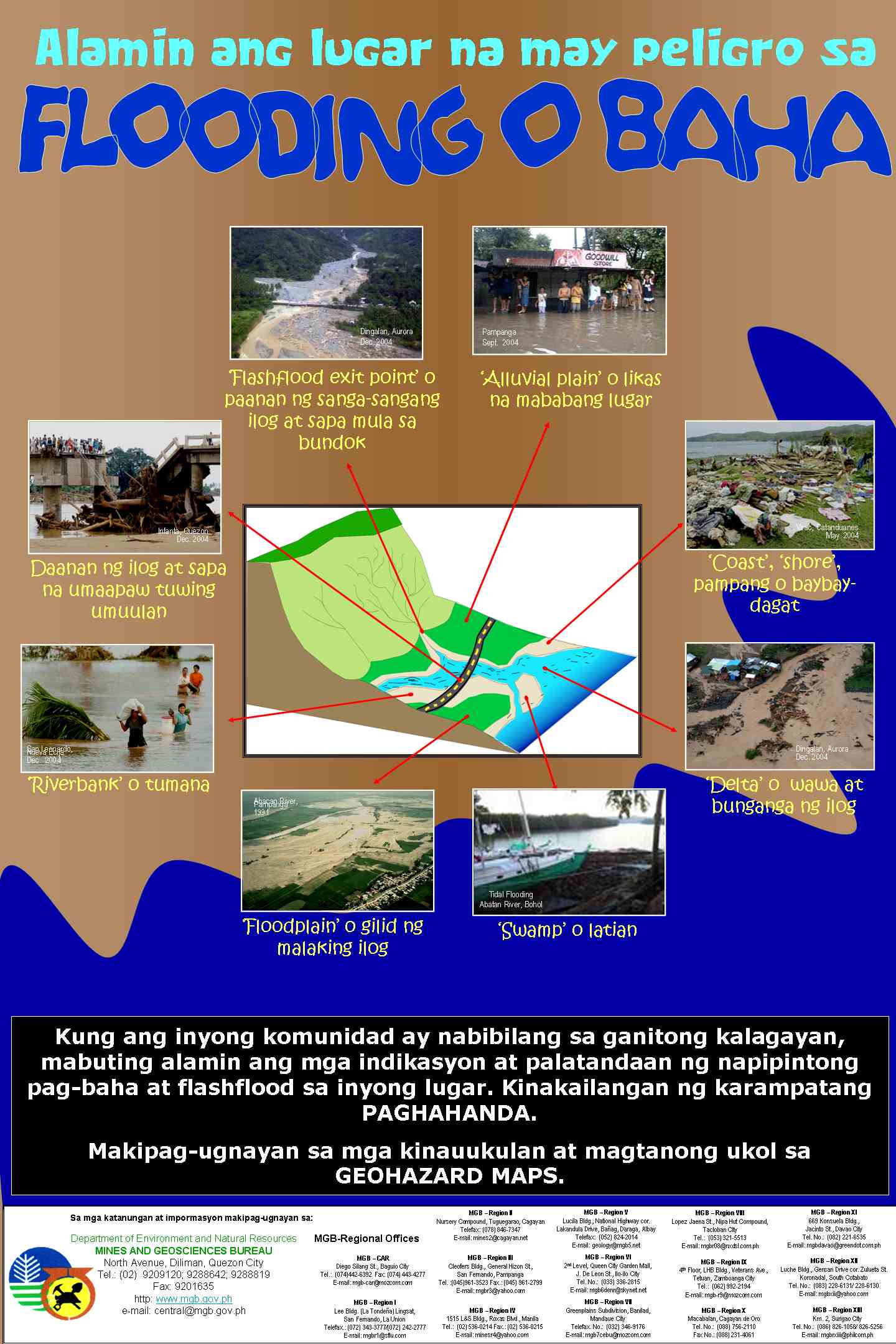
in the region is also one of the problems during and after prolonged rainfall. Areas near bodies of water such as rivers, creeks, lakes, canals, former river channels have been mapped as highly susceptible to flooding.
Director Juguan mentioned that information on geohazards is crucial in the government’s thrust on disaster management and mitigation to prevent the loss of lives and properties brought about by natural disasters.
The MGB geohazards assessment team gave the barangays an advisory to let them know the classification of their areas in the landslide susceptibility rating. Geohazard assessment results and copies of completed geohazard maps were also given to the LGUs.
RD Juguan said that in the first quarter of this year, DENR Secretary Ramon J.P. Paje ordered all the regional offices to reiterate the geohazards information given to the LGUs in Region 6. Letters were sent to all the city and municipal mayors giving them the list of barangays that are classified as high and moderate in the landslides susceptibility assessment.
May 23, 2011
The Mines and Geosciences Bureau in Region 6 (MGB-6) cleared that a small scale mining operation in Barangay Badiangan, Ajuy, Iloilo did not cause soil erosion and landslides as previously reported in local papers.
Regional Director Leo Van V. Juguan of MGB-6 said that the Multipartite Monitoring Team (MMT) of the Mine Rehabilitation Fund Committee (MRFC) for the Province of Iloilo conducted an investigation on April 14, 2011 to verify a complaint and news report against Pacific Ore and Minerals Exploration Development Corporation (POMEDCO).
The MMT-MRFC is spearheaded by MGB-6 with representatives from the Environmental Management Bureau, Provincial Environmental and Natural Resources Office (PENRO)-LGU Iloilo, Community Environmental and Natural Resources Office (CENRO) Iloilo and CENRO Barotac, and Process Foundation.
Director Juguan said that MGB-6 received a letter from Barangay Kagawad Renato Baluro of Barangay Badiangan, Ajuy, Iloilo complaining about illegal mining activities of POMEDCO in his barangay. Barangay Kagawad Baluro also complained that the mining company did not inform the concerned barangays of its project.
The Provincial Environmental and Natural Resources Office (PENRO) of the Province of Iloilo also conducted a field investigation on April 7, 2011.
“Both investigation reports of PENRO Iloilo and MMT-MRFC Iloilo noted that there were no traces of the alleged soil erosion within the mining area. This was confirmed by residents frequenting the area,” clarified Director Juguan.
The two investigation reports concurred that the reported landslide was not caused by the mining activity as it is located 200-250 meters away from the mining area.
The landslide occurred way before the mining activity started, and in fact, presence of vegetation on the landslide area was already noticeable during the time of investigation, according to the investigation reports.
Clarifying the issue that the company is into illegal mining, Director Juguan cited the investigation reports saying that a small scale mining permit was issued by the Province of Iloilo on December 23, 2010 while an Environmental Compliance Certificate (ECC) was issued by the Environmental Management Bureau on July 19, 2010 to POMEDCO.
The ECC is one of the major requirements prior the approval and issuance of a mining permit.
The investigation reports also noted documents showing the mining proponent conducted several public hearings in the barangays covered by its small scale mining permit. (MGB-6)
See related story at:
Philippine Information Agency:
“MGB-6 says small scale mining not cause of town landslides”
The News From the Capitol:
“PENRO: No truth to complaints vs. Ajuy mining operator”
May 16, 2011
The MGB strongly supports the positive stand of stakeholders and public officials in Negros Occidental towards responsible mining, according to the Regional Director of the Mines and Geosciences Bureau (MGB)-6.
In a press statement issued yesterday, Director Juguan affirmed that Negros Occidental Vice Governor Genaro Alvarez is right in saying that mining can create opportunities for employment and economic development should responsible mining operations push through in potential areas in southern Negros.
“The southern part of Negros Occidental has always been recognized as one of the mining districts of the country because of its high potential for mineral resources,” the MGB-6 Director said.
“We believe that Gov. Alfredo Marañon Jr., Vice Gov. Genaro Alvarez and other public officials in the province must have recognized the economic benefits that responsible mining may bring in the province.” Director Juguan added.
“The present mining law, R.A. 7942, has stringent provisions in ensuring that mining operations should be done in a responsible manner under the principle of sustainable development. These are environmental guarantee measures to ensure that the impacts of mining to the environment are fully addressed and mitigated. Director Juguan further stressed that as a mining engineer, he does not believe in the desertification of a province provided mining operations are done in a responsible manner.”
When asked about issues hurled against mining citing past bad experiences, Director Juguan said that indeed, in the past, there was an absence of clear-cut provisions in the mining law and its regulations in ensuring that the environmental impacts are addressed in each stage of mining, so as not to cause environmental destruction.
Director Juguan, however, said that he fully respects the varied opinions on mining as each one has a stake on the environment. He also recognized that these statements are mostly due to fears and apprehensions of perceived effects mining might have on the environment.
“The government does not want mining accidents and disasters to happen. It has put in place mechanisms to ensure that mining companies implement the necessary environmental measures in every aspect of mining operations. The provisions of the law ensure that responsible mining must absorb most particularly the social, environmental, and technical costs in all phases of mining operations,” Director Juguan said.
See related stories in:
The Visayan Daily Star
Philippine Information Agency